Networking Deep Dive
Andrew Pareles (@Kubester)
Networking
This is a blog post about how we designed the networking on Kube.new. Yes, the networking code is written from scratch on QUIC datagrams.
There is a fundamental problem you face building any game engine: it takes time for your inputs to reach other players and vice versa. When building the networking for Kube.new there were two axioms I used:
Axiom 1: When you press WASD you should move immediately on your screen, even though the server won't have received the message yet. This axiom is easy, we just immediately apply inputs to the player's own character object.
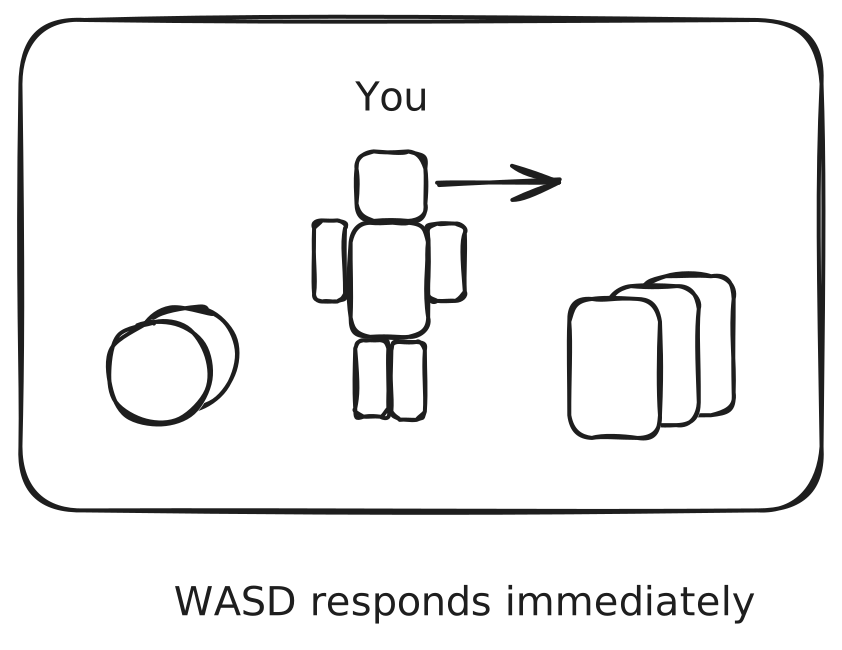
Axiom 2: It's desirable for players to see changes happen in sync, even though they'll always be delayed in time. The most elegant solution we could come up with is to delay the world on your computer, and timestamp every change so that they can be applied in sync.
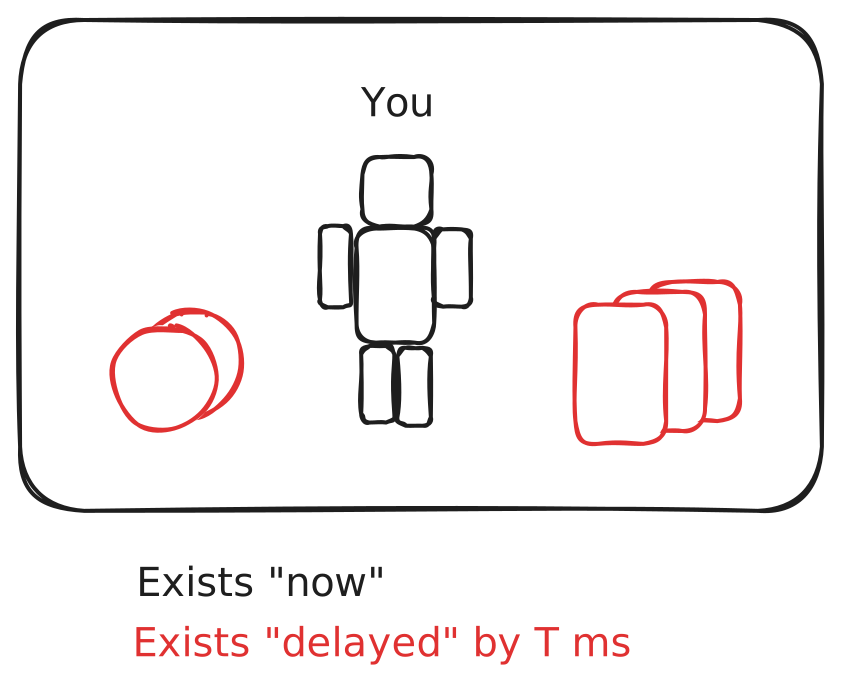
This axiom is harder, because we need to (1) pick a world delay amount, which we'll call T and (2) implement timestamps.
We talk about implementing timestamps below. For now we'll just talk about picking T. It's kind of obvious that T must be at least your round-trip ping1, or else there's no point in having the delay in the first place; anything that reached you would be after the delay, so you'd miss the effect completely. So at minimum, let T = ping. I also add on an extra 50ms for jitter, where packets take a little extra time to arrive, and 16ms to give us extra time to interpolate between the latest 2 physics steps (16ms = 1/60Hz = physics step period).
T = ping + 50ms + 16ms.
So to recap, on your client all objects live T milliseconds in the past, except for: (1) your own character and (2) anything affecting it like WASD inputs, animations, etc.2
Server-Side
On Kube.new the server is authoritative, meaning it is the only place that can create, move, and delete objects. This means it needs to communicate the changes that happen with each player, 60 times a second. This sounds simple, but it requires implementing a networking protocol.
We are using QUIC datagrams for our networking so we don't deal with the problems of TCP3, but that comes with two problems we then have to address: packets can be dropped, and the byte limit is 1200 bytes.
To deal with the byte limit, we ensure all objects in our world are designed to take up O(1) space. For example, it's sometimes tempting to have a struct like this, which can grow arbitrarily large.
// ⚠️ Objects should never have arbitrary size. ⚠️struct BadAnimationObject { duration: f32, frames: Vec<Keyframe>}Instead of doing that, we always break objects down into O(1) components:
// ✅ All objects are O(1) size.struct GoodAnimationObject { duration: f32,}struct Keyframe { parent_animation_id: u32}This is a small design detail, but it means we never have to break down big objects into multiple packets since all items are below 1200B.
This way, all objects are treated the same in the netcode. We just have one algorithm to build a message to the client - keep cramming objects into our message to the client until it's full.
The server sends ClientMsg to each client, 60 times a second.
// Changes for 1 object.struct ObjectDelta { parent_id: Option<ObjectId>, physics: Option<Vec12>, color: Option<Color4>, name: Option<String>, etc: Option<EtcEtc>,}// We want to send this to each client 60x/sec.struct ClientMsg { server_timestamp: f32, message_num: u64, changes: HashMap<ObjectId, ObjectDelta>,}Ok, so ClientMsg is the shape of message we send to each client. But if the server just made a ton of changes, how does it remember them all? It can only fit so many changes into a message at once.
Well, the server must remember all the "dirty" changes that eventually need to get sent. Every tick, the server adds all the items that changed to a "dirty" queue. It then pops as many items as it can cram into the next message. Those items might get dropped over the network and need to be resent, so we can't just delete them the moment we send them. That means we need another queue called "unacked" that we move the items into. We resend unacked items if they haven't been ACK'd for a while.
To recap: the server stores 2 queues. A dirty queue to remember all the changes it needs to send, and an "unacked" queue so it can resend changes that were never ACK'd by the client.
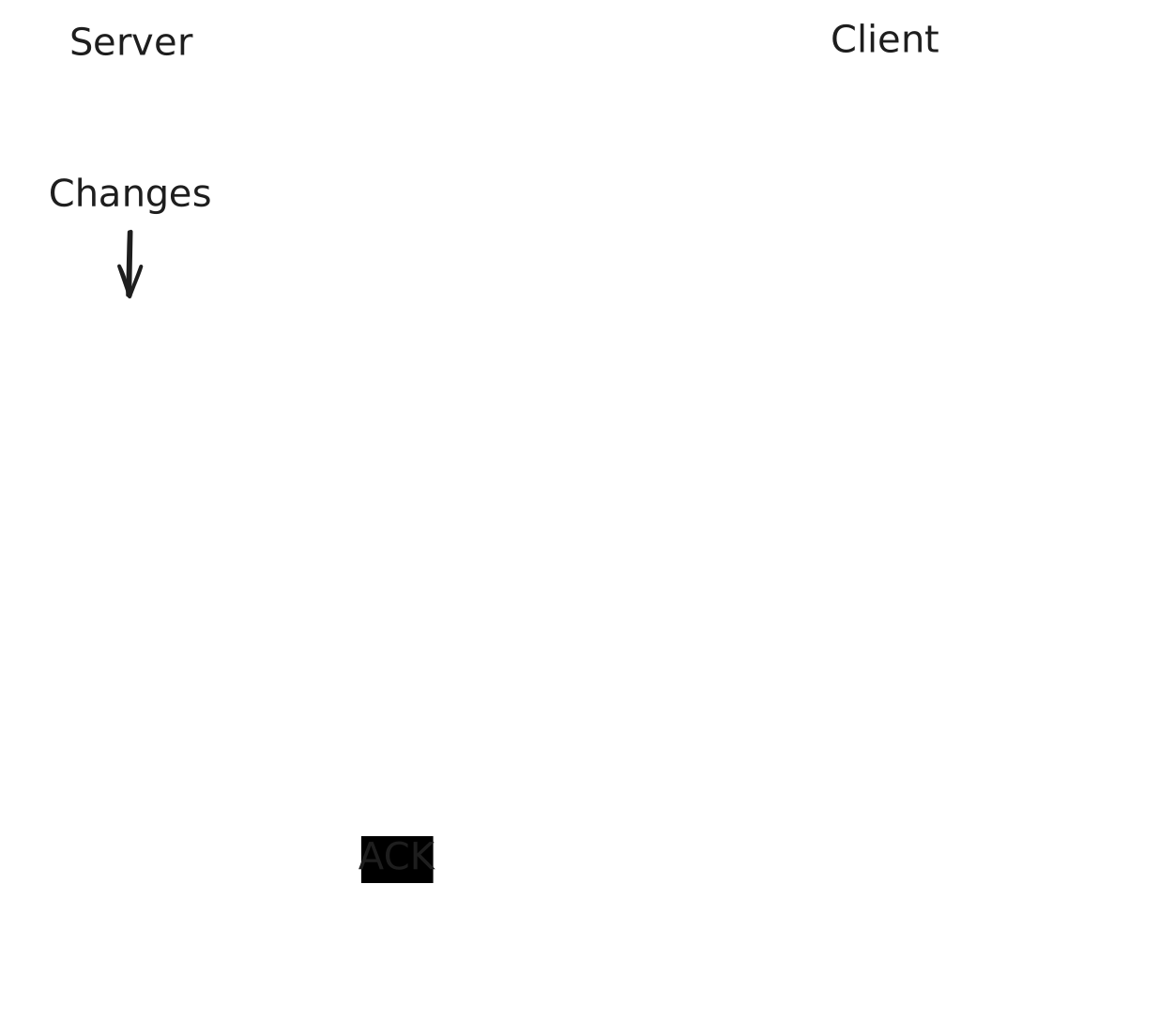
Here's the idea in code4:
// Changes for 1 object. Just indicator bools saying what to read + send.struct ObjectDeltaFlags { parent_id: bool, physics: bool, color: bool, name: bool, etc: bool,}type DirtyQueue = HashMapQueue<ObjectId, ObjectDeltaFlags>type UnackedQueue = HashMapQueue<ObjectId, ObjectDeltaFlags>// 60x/sec the server calls this for each client:fn send_client_msg(client_id: u64) { let mut dirty = dirty_queue[client_id]; let mut unacked = unacked_queue[client_id]; let client_msg: ClientMsg = f(&mut dirty, &mut unacked); sendTo(client_id, client_msg); }The queues are organized by ObjectId, not message_num, so that we can be very granular and avoid sending individual objects that were already sent more recently.
What The Client Does
Now we know the shape of message that the server sends to each client, ClientMsg. It contains all the changes the client should apply, like "add a ball to XYZ position" or "move this player to XYZ". The client uses the timestamps on the messages to apply changes at the correct time.
There are a few problems, though - a client can receive their ClientMsg packets reordered, duplicated, or dropped.
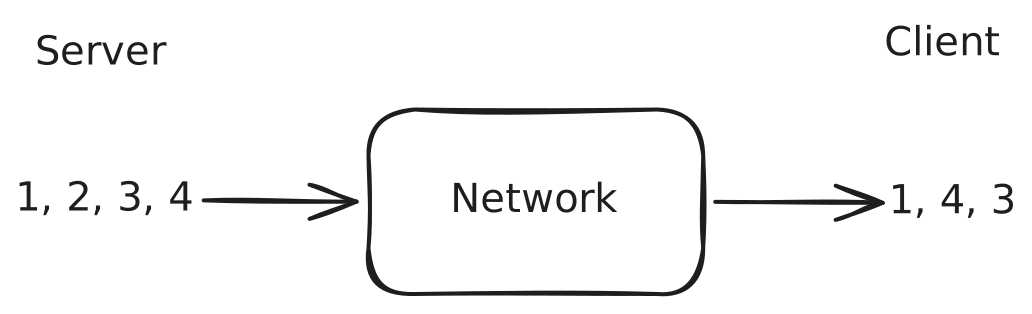
We can fix this by having the client simply accept the latest message_num that it gets given the same object id. That way, eventually the client will get the correct updates. However, that only works if all changes commute (are order-independent)! This is a more powerful statement than idempotence, so it's a little hard to get right.
For example, if an object's parent wasn't received yet but you wrote all your logic to assume that (like I did), then you will have ordering bugs. It's basically hysteresis for your game due to errors in one order but not the other. The packets could genuinely arrive in any order, and you need to allow for both orders if you want commutative behavior.
fn createObject(object_id: u64, parent_id: u64) { let Some(parent) = getObject(parent_id) else { // ⚠️ Not allowed if we want pure commutative behavior! ⚠️ return Err("Parent does not exist") }; // ... More logic to set up the object ...}I found myself writing really complex logic to get commutation to work with an object's parent, and it wasn't scalable. So I actually removed the commutative requirement on this function. I made the client just wait until the parent does exist. I did this on the network layer, so the client never sees an object change until it receives the parent too.
This feels a lot like re-implementing TCP - we're waiting for packets to arrive in a certain order on the networking layer! However, it's not a perfect linear ordering like what you have with TCP; it's just a local topological sort where we wait for parents before children. It's very localized. And in practice it's rare and usually the behavior you want anyway.
// Client runs this as their network layer:fn popDueChanges() -> Vec<ObjectDelta> { let latest_msg: ClientMsg = network.recv().await; let mut changes_due = Vec::new(); for change in latest_msg.changes { // ensure T ms in the past if !change_is_due(latest_msg.server_timestamp) { // store for later continue; } // ensure objects have a parent if !has_parent_yet(change) { // store for later continue; } changes_due.push(change); } return changes_due;}I had the same problem when trying to write code for adding, modifying, and removing objects. They simply don't commute. For example, it's not possible to modify an object without knowing what shape it is, which you only learn in the "add" message. So again, the fix is to guarantee ordering. We need to guarantee the client gets messages in the order Add -> Modify -> Remove.
I implemented this slightly differently from the parent/child idea. The ordering guarantee is done by the server, not the client. The reason is that it's best practice to make sure the client got every modify before removing the object, and that's much simpler for the server to do than the client. While the server is doing that, it might as well also guarantee the Add -> Modify -> Remove ordering. Again, this is like re-implementing TCP, but it's a very local sort, not a full linear TCP ordering.
// This lives on the server.fn send_client_msg() { // ✅ Slightly modify this function we wrote earlier. // We guarantee the client: // 1. ACK'd Add before sending Modify, // 2. ACK'd all Modifies before sending Remove}With these changes, all the functions commute, and the networking is valid!
Ok, so the client receives the server's messages properly.
Now we need to make the client send messages to the server. Here's what we want the client to send:
// Clients send this to the server 60x/sec.struct ServerMsg { input_num: MessageNum, // client's message num estimated_server_timestamp: f32, // estimated time on server acks: Vec<MessageNum>, // msgs that are being ACK'd location: PhysicsInfo3D, // where the character is}This is very close to what we end up implementing. However, there's a small problem if we just implement this. Notice that both the client and server can move the character. If the client just sends the ServerMsg 60 times a second as-is, then the server won't be able to make changes to any clients (e.g. teleport them). The change will happen for a split second, and then the client will just override it.
// The server runs this:let players = objectService.getObjectByType("player")let somePlayer = players[0]let character = objectService.getObjectById(somePlayer.characterObjectId)// ⚠️ The client will incorrectly override the server in these cases! ⚠️character.location.x = 10character.movement.x = 20character.location = { x: 10, y: 10, z: 10 }character.movement = { x: 20, y: 20, z: 20 }somePlayer.characterObjectId = 56We can fix this by making the server ignore all of the client's messages that are about their own character, until the client has ACK'd these specific-case changes.
// ✅ Server runs this to fix the above problem.fn receive_client_msg(client_id: u64, msg: ServerMsg) { let mut acks_needed: &mut HashSet<MessageNum> = acks_needed_of_client[client_id]; for ack in msg.acks { acks_needed.remove(ack); } // Only apply the client's changes to the character if acks_needed is empty. if acks_needed.is_empty() { // Update character. }}This completes the networking protocol between server and client!
Clock Synchronization
It's important to have accurate timestamps if we want clients to properly show a delayed world. But how do we actually sync clocks across the network to get accurate timestamps?
Well, we use NTP (Network Time Protocol). The basic idea is that the client constantly pings the server asking it for its current time. The server responds, and the client corrects for how long the response took and averages out those responses. It's one of the simplest possible algorithms you could devise to do timestamps, and it's conventional5.
This means the time will practically be the same time no matter where you read it!
We even use timestamps in other places - you can do complex animations with PropertyAnimator or SkAnimator. They both take advantage of the timestamps to sync animations, using Clock objects.
Physics Engine
The physics engine we're using has two types of objects: dynamic (experience physics) and kinematic (do not experience physics). We decided the objects that you own like your character should be dynamic so you can simulate them, and everything else should be kinematic. For example, if the server tells you an object is at x=100, you just move it there kinematically, and it never moves away.
Client
- Dynamic: Your character.
- Kinematic: Everything else.
Server
- Kinematic: All characters.
- Dynamic: Everything else.
This makes control very simple and guaranteed to be correct. However, one negative consequence is that you can't really push things unless scripts are involved, because basically everything is kinematic on your client. We may add a fix for this which requires transferring object ownership to the client, but we're focused on great multiplayer right now, not physics-based games.
Thanks For Reading!
I hope this gives you a sense of what went on behind the scenes to build the networking behind Kube.new! We did a lot so that neither you nor your AI have to think about networking details.
Footnotes
-
It's tempting to make T equal to the laggiest player's ping, so that your client can smooth even the laggiest player. However, that allows high ping players to make the game a more delayed experience for everyone, so we decide to just not do that and let them appear choppy if they are above the threshold. ↩
-
For completeness but unrelated to our discussion, also (3) client-side timers, which only run locally so have no reason to be delayed. ↩
-
TCP works on the OS level to make sure every message is read by your application in perfect order. If one packet is dropped, your whole game freezes and waits for it. ↩
-
In reality our message to the client also includes
Adds,Removes, andForeignModifies(other players' inputs) - not justObjectDelta- but they're all versions of the same idea. ↩ -
A simpler algorithm might be to just use
estimated_server_time = initial_time_server_said + current_rtt()/2. However it could theoretically drift if anyone's clock is relatively slow. ↩